lititzbmx-docs
Chapter 4, Page 38
| Previous page | Campaign index | Next page |
Campaign: A Fireside Story of Harry Leary
Stable page identifier: FSHL-038
Chapter: 4 — Built Through Repetition
Source page: Open the original Lititz BMX page
Record blocks: 3
Capture components: 1
Archive status: Canonical source capture preserved
Canonical page capture
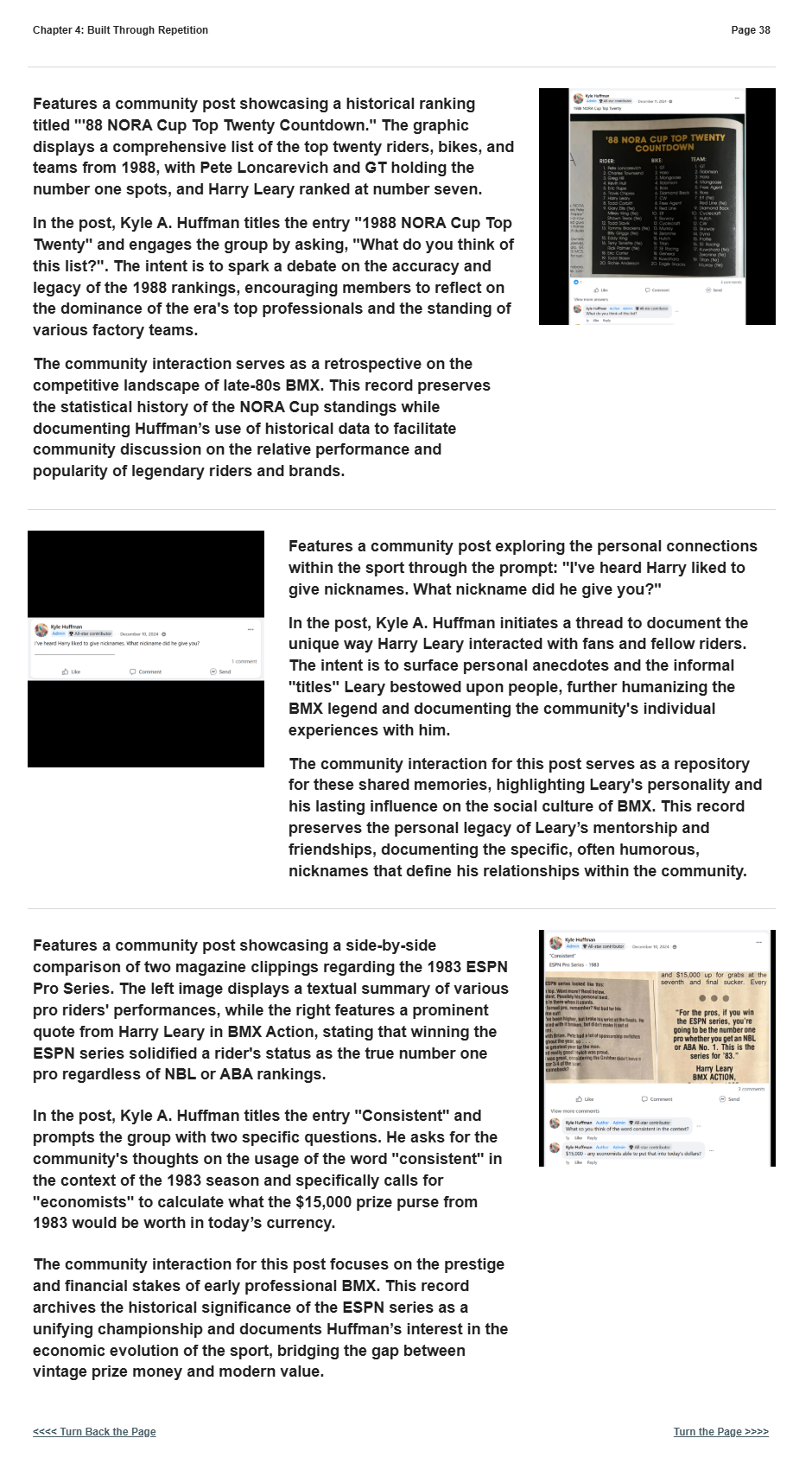
The image above is the controlling visual source record. Unique content is preserved only through “Turn the Page.” Recycled material below that boundary is excluded under the campaign capture protocol.
Record-block summaries
Record block 1 — FSHL-038-01
Features a community post showcasing a historical ranking
Record block 2 — FSHL-038-02
Features a community post showcasing a side-by-side 1B OTe °
Record block 3 — FSHL-038-03
popularity of legendary riders and brands. Features a community post exploring the personal connections within the sport through the prompt: “I’ve heard Harry liked to give nicknames. What nickname did he give you?”
Searchable archival transcription
Transcription status: Machine-assisted extraction from the supplied canonical page capture. It supports discovery and accessibility but does not replace the image as evidence. Apparent wording conflicts must be checked against the capture and source page.
Features a community post showcasing a historical ranking
titled “88 NORA Cup Top Twenty Countdown.” The graphic
displays a comprehensive list of the top twenty riders, bikes, and
teams from 1988, with Pete Loncarevich and GT holding the i,
number one spots, and Harry Leary ranked at number seven.
In the post, Kyle A. Huffman titles the entry “1988 NORA Cup Top ee
Twenty” and engages the group by asking, “What do you think of Be
this list?”. The intent is to spark a debate on the accuracy and re
legacy of the 1988 rankings, encouraging members to reflect on .
the dominance of the era’s top professionals and the standing of 8 mm
various factory teams.
The community interaction serves as a retrospective on the
competitive landscape of late-80s BMX. This record preserves
the statistical history of the NORA Cup standings while
documenting Huffman’s use of historical data to facilitate
community discussion on the relative performance and
popularity of legendary riders and brands. Features a community post exploring the personal connections within the sport through the prompt: “I’ve heard Harry liked to give nicknames. What nickname did he give you?”
Eee . In the post, Kyle A. Huffman initiates a thread to document the
tenant cre wt ene ate unique way Harry Leary interacted with fans and fellow riders. The intent is to surface personal anecdotes and the informal “titles” Leary bestowed upon people, further humanizing the BMX legend and documenting the community’s individual experiences with him. The community interaction for this post serves as a repository for these shared memories, highlighting Leary’s personality and his lasting influence on the social culture of BMX. This record preserves the personal legacy of Leary’s mentorship and friendships, documenting the specific, often humorous, nicknames that define his relationships within the community.
Features a community post showcasing a side-by-side 1B OTe °
comparison of two magazine clippings regarding the 1983 ESPN cre snc s}s000-up wor abe awe
| Pro Series. The left image displays a textual summary of various a | ee w |
| pro riders’ performances, while the right features a prominent = | tone |
quote from Harry Leary in BMX Action, stating that winning the ee
ESPN series solidified a rider’s status as the true number one oe ie ed
pro regardless of NBL or ABA rankings. ska,
In the post, Kyle A. Huffman titles the entry “Consistent” and 6a
prompts the group with two specific questions. He asks for the 0S
community’s thoughts on the usage of the word “consistent” in ONE Somers
the context of the 1983 season and specifically calls for
“economists” to calculate what the $15,000 prize purse from
1983 would be worth in today’s currency.
The community interaction for this post focuses on the prestige
and financial stakes of early professional BMX. This record
archives the historical significance of the ESPN series as a
unifying championship and documents Huffman’s interest in the
economic evolution of the sport, bridging the gap between
vintage prize money and modern value.
Source and preservation notes
- The page remains one stable campaign occurrence even when the same post or poll appears elsewhere.
- Social-media memories, comments, predictions, and disputed details remain attributable to their speakers in the source image.
- Embedded media shown within this page belongs to this page record and is not counted as an additional campaign page.
- People in photographs are not identified beyond names explicitly present in the source material.
| Previous page | Campaign index | Next page |