lititzbmx-docs
Chapter 4, Page 42
| Previous page | Campaign index | Next page |
Campaign: A Fireside Story of Harry Leary
Stable page identifier: FSHL-042
Chapter: 4 — Built Through Repetition
Source page: Open the original Lititz BMX page
Record blocks: 3
Capture components: 1
Archive status: Canonical source capture preserved
Canonical page capture
The image above is the controlling visual source record. Unique content is preserved only through “Turn the Page.” Recycled material below that boundary is excluded under the campaign capture protocol.
Record-block summaries
Record block 1 — FSHL-042-01
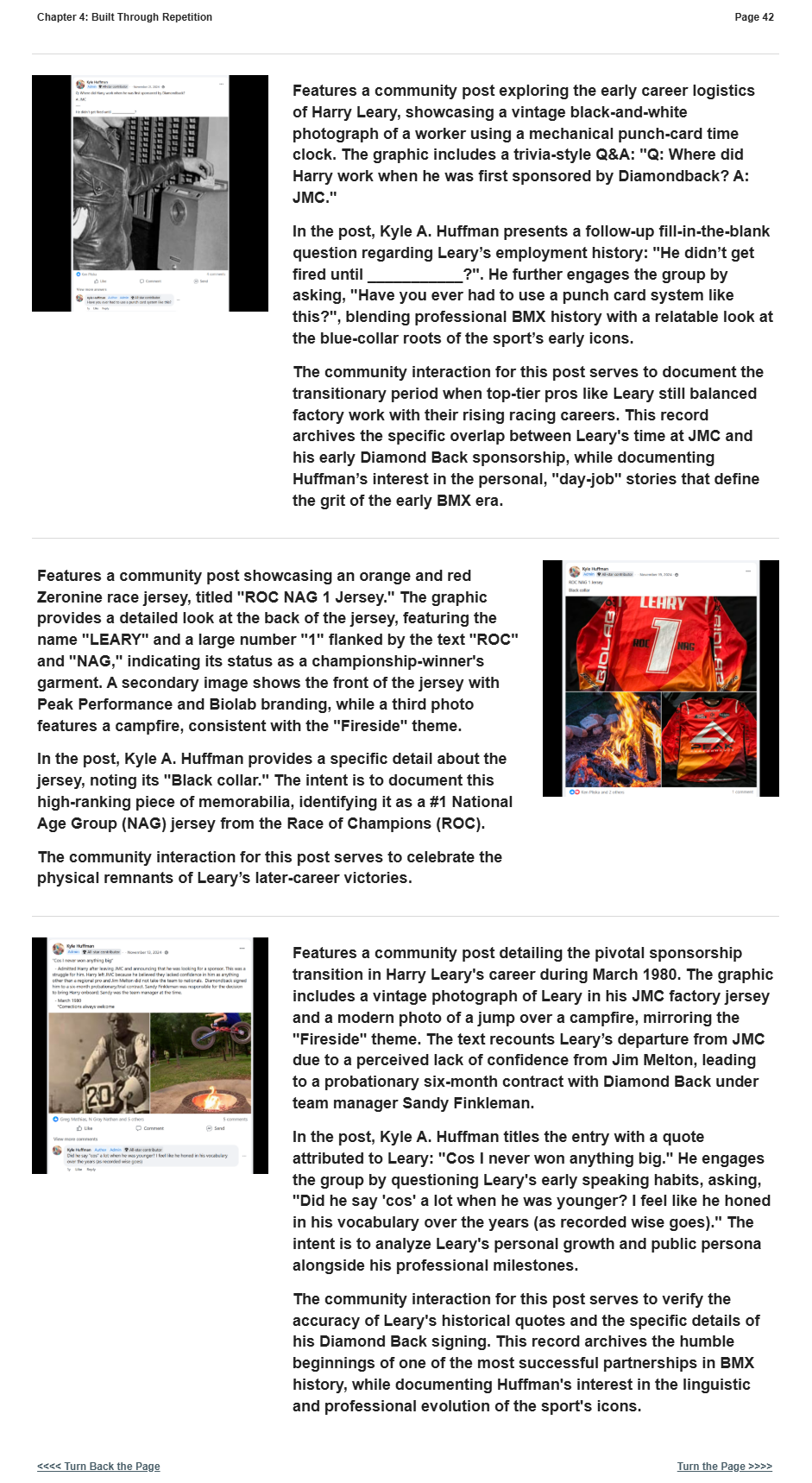
| esti soa Features a community post exploring the early career logistics —_ of Harry Leary, showcasing a vintage black-and-white lv : : = Bs = photograph of a worker using a mechanical punch-card time # : 5 clock. The graphic includes a trivia-style Q&A: “Q: Where did . > \ a | Harry work when he was first sponsored by Diamondback? A: i 4 r In the post, Kyle A. Huffman presents a follow-up fill-in-the-blank — question regarding Leary’s employment history: “He didn’t get — - fired until ?”. He further engages the group by (oe asking, “Have you ever had to use a punch card system like this?”, blending professional BMX history with a relatable look at the blue-collar roots of the sport’s early icons. The community interaction for this post serves to document the transitionary period when top-tier pros like Leary still balanced factory work with their rising racing careers. This record archives the specific overlap between Leary’s time at JMC and his early Diamond Back sponsorship, while documenting Huffman’s interest in the personal, “day-job” stories that define the grit of the early BMX era. Features a community post showcasing an orange and red | Aeros ° Zeronine race jersey, titled “ROC NAG 1 Jersey.” The graphic = HRY | provides a detailed look at the back of the jersey, featuring the up 4 a name “LEARY” and a large number “1” flanked by the text “ROC” J | i) and “NAG,” indicating its status as a championship-winner’s oO A I hit garment. A secondary image shows the front of the jersey with 38 AS Peak Performance and Biolab branding, while a third photo Ny n { features a campfire, consistent with the “Fireside” theme. ) : | Za, In the post, Kyle A. Huffman provides a specific detail about the : ~ jersey, noting its “Black collar.” The intent is to document this high-ranking piece of memorabilia, identifying it as a #1 National “ Age Group (NAG) jersey from the Race of Champions (ROC). The community interaction for this post serves to celebrate the physical remnants of Leary’s later-career victories. b Ralaoinond . Features a community post detailing the pivotal sponsorship seer pet aa transition in Harry Leary’s career during March 1980. The graphic Se includes a vintage photograph of Leary in his JMC factory jersey — ro and a modern photo of a jump over a campfire, mirroring the 1 * “Fireside” theme. The text recounts Leary’s departure from JMC f y y due to a perceived lack of confidence from Jim Melton, leading d fon a 5” to a probationary six-month contract with Diamond Back under 1a} Ab al team manager Sandy Finkleman. ° - In the post, Kyle A. Huffman titles the entry with a quote bedi Cnet attributed to Leary: “Cos I never won anything big.” He engages the group by questioning Leary’s early speaking habits, asking, “Did he say ‘cos’ a lot when he was younger? | feel like he honed in his vocabulary over the years (as recorded wise goes).” The intent is to analyze Leary’s personal growth and public persona alongside his professional milestones. The community interaction for this post serves to verify the accuracy of Leary’s historical quotes and the specific details of his Diamond Back signing. This record archives the humble beginnings of one of the most successful partnerships in BMX history, while documenting Huffman’s interest in the linguistic and professional evolution of the sport’s icons. |
Record block 2 — FSHL-042-02
See the canonical page capture for the complete visual record and published page context.
Record block 3 — FSHL-042-03
See the canonical page capture for the complete visual record and published page context.
Searchable archival transcription
Transcription status: Machine-assisted extraction from the supplied canonical page capture. It supports discovery and accessibility but does not replace the image as evidence. Apparent wording conflicts must be checked against the capture and source page.
| esti soa Features a community post exploring the early career logistics —_ of Harry Leary, showcasing a vintage black-and-white lv : : = Bs = photograph of a worker using a mechanical punch-card time # : 5 clock. The graphic includes a trivia-style Q&A: “Q: Where did . > \ a | Harry work when he was first sponsored by Diamondback? A: i 4 r In the post, Kyle A. Huffman presents a follow-up fill-in-the-blank — question regarding Leary’s employment history: “He didn’t get — - fired until ?”. He further engages the group by (oe asking, “Have you ever had to use a punch card system like this?”, blending professional BMX history with a relatable look at the blue-collar roots of the sport’s early icons. The community interaction for this post serves to document the transitionary period when top-tier pros like Leary still balanced factory work with their rising racing careers. This record archives the specific overlap between Leary’s time at JMC and his early Diamond Back sponsorship, while documenting Huffman’s interest in the personal, “day-job” stories that define the grit of the early BMX era. Features a community post showcasing an orange and red | Aeros ° Zeronine race jersey, titled “ROC NAG 1 Jersey.” The graphic = HRY | provides a detailed look at the back of the jersey, featuring the up 4 a name “LEARY” and a large number “1” flanked by the text “ROC” J | i) and “NAG,” indicating its status as a championship-winner’s oO A I hit garment. A secondary image shows the front of the jersey with 38 AS Peak Performance and Biolab branding, while a third photo Ny n { features a campfire, consistent with the “Fireside” theme. ) : | Za, In the post, Kyle A. Huffman provides a specific detail about the : ~ jersey, noting its “Black collar.” The intent is to document this high-ranking piece of memorabilia, identifying it as a #1 National “ Age Group (NAG) jersey from the Race of Champions (ROC). The community interaction for this post serves to celebrate the physical remnants of Leary’s later-career victories. b Ralaoinond . Features a community post detailing the pivotal sponsorship seer pet aa transition in Harry Leary’s career during March 1980. The graphic Se includes a vintage photograph of Leary in his JMC factory jersey — ro and a modern photo of a jump over a campfire, mirroring the 1 * “Fireside” theme. The text recounts Leary’s departure from JMC f y y due to a perceived lack of confidence from Jim Melton, leading d fon a 5” to a probationary six-month contract with Diamond Back under 1a} Ab al team manager Sandy Finkleman. ° - In the post, Kyle A. Huffman titles the entry with a quote bedi Cnet attributed to Leary: “Cos I never won anything big.” He engages the group by questioning Leary’s early speaking habits, asking, “Did he say ‘cos’ a lot when he was younger? | feel like he honed in his vocabulary over the years (as recorded wise goes).” The intent is to analyze Leary’s personal growth and public persona alongside his professional milestones. The community interaction for this post serves to verify the accuracy of Leary’s historical quotes and the specific details of his Diamond Back signing. This record archives the humble beginnings of one of the most successful partnerships in BMX history, while documenting Huffman’s interest in the linguistic and professional evolution of the sport’s icons. |
Source and preservation notes
- The page remains one stable campaign occurrence even when the same post or poll appears elsewhere.
- Social-media memories, comments, predictions, and disputed details remain attributable to their speakers in the source image.
- Embedded media shown within this page belongs to this page record and is not counted as an additional campaign page.
- People in photographs are not identified beyond names explicitly present in the source material.
| Previous page | Campaign index | Next page |