lititzbmx-docs
The Netherlands
Exhibit
International BMX History → The Netherlands
Original URL
Canonical page transcription
From Amersfoort Dirt to the Olympic Stage
The Netherlands BMX History: From Early Dirt Racing to Olympic Success
The Early Roots of Bicycle Motocross
While organized 20-inch BMX emerged in Southern California during the late 1960s, the Netherlands holds some of the earliest documented European roots of bicycle motocross. As early as the late 1950s, Dutch youth in cities including Amersfoort were adapting heavy road bicycles for off-road racing on dirt circuits inspired by motorcycle motocross culture.
These early grassroots races established a strong cycling foundation that later helped the Netherlands become one of Europe’s most important BMX nations.
The 1970s and the Rise of Organized BMX
Modern BMX began rapidly expanding throughout the Netherlands during the late 1970s through the efforts of Dutch motocross coach Gerrit Does. After studying the emerging American BMX scene, Does helped establish organized BMX racing structures in Europe, including the founding of the SFN (Stichting Fietscross Nederland) and the development of one of Europe’s earliest modern BMX tracks in Eindhoven in 1979.
In 1981, Does became one of the co-founders of the International BMX Federation (IBMXF), helping position the Netherlands as a leading force in the international growth and organization of BMX racing.
The 1980s Boom and International Expansion
During the 1980s, BMX exploded in popularity throughout the Netherlands. One of the defining moments of the era came in 1983 when Slagharen hosted the IBMXF World Championships, one of the most significant early international BMX events in Europe.
As BMX expanded nationally, Dutch tracks and clubs increasingly modernized their infrastructure while factory sponsorships and international competition strengthened the country’s racing scene. The Netherlands quickly developed a reputation for fast, technically efficient racing and highly organized event management.
The 1990s and UCI Integration
The 1990s marked an important institutional transition period for international BMX. In 1993, the IBMXF officially merged into the Union Cycliste Internationale (UCI), helping integrate BMX into the global cycling structure.
Dutch riders remained highly competitive during this era, including Bas de Bever, who became one of Europe’s leading elite BMX racers. At the same time, freestyle BMX and flatland riding continued developing throughout the Netherlands alongside traditional racing culture.
The Olympic Era and Modern Dutch BMX
The Netherlands further strengthened its international BMX reputation during the Olympic era following BMX racing’s debut at the 2008 Beijing Games. Supported by elite training infrastructure at Papendal, the Dutch national program developed into one of the world’s strongest BMX systems.
This era produced internationally successful riders including Niek Kimmann, who won Olympic gold at the Tokyo Games. Today, the Netherlands continues balancing elite Olympic competition with a strong appreciation for BMX heritage through vintage BMX groups, historical preservation efforts, and long-running local club culture.
Media inventory
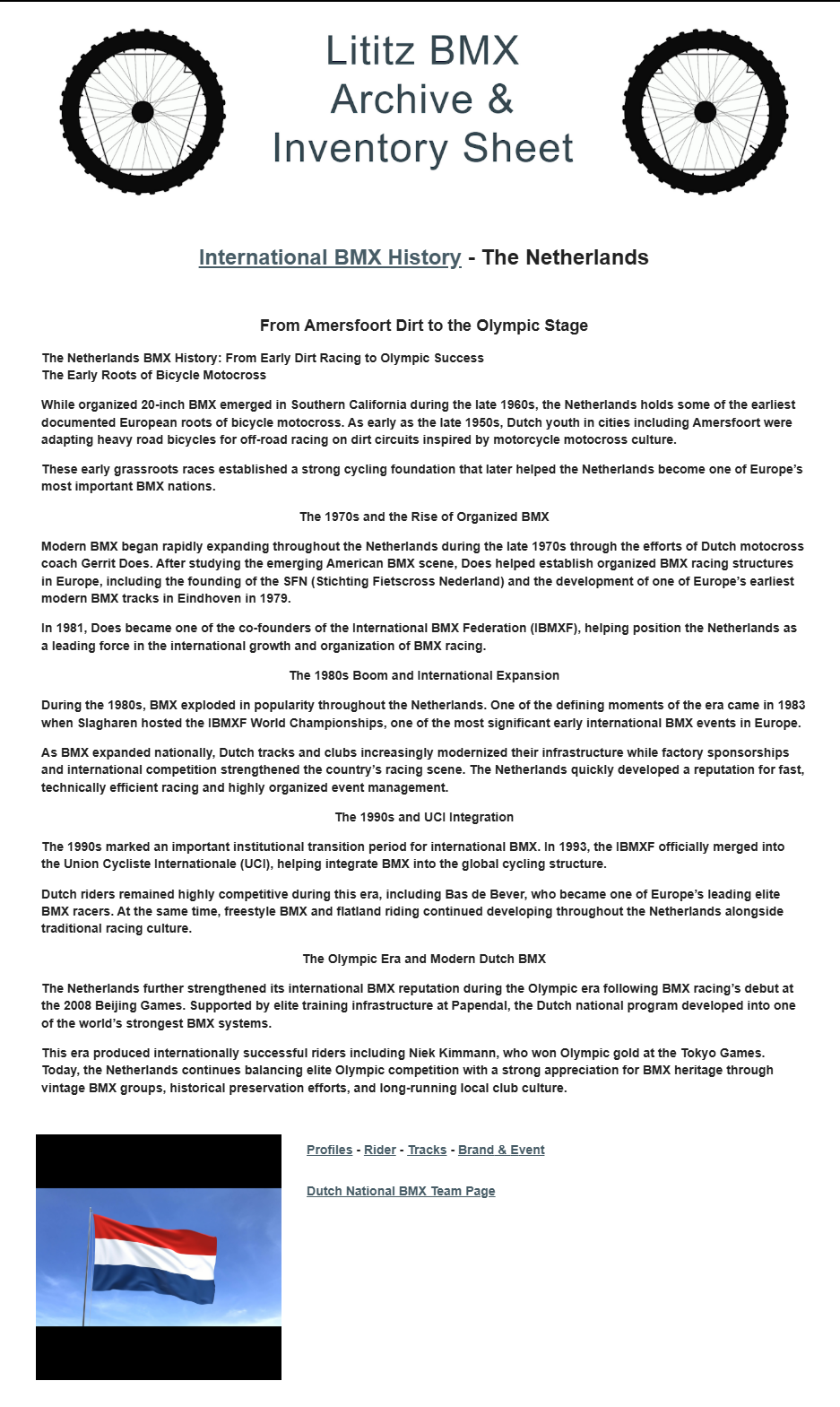
- Visible source images: National flag image displayed beneath the narrative.
- Embedded videos: None visibly embedded in the supplied page capture.
Exhibit metadata
| Field | Value |
|---|---|
| Record ID | IBH-002 |
| Collection | International BMX History |
| Country | The Netherlands |
| Page class | Country History |
| Category | Country |
| Published heading | The Netherlands |
| Visible images/tiles | 1 |
| Source capture | source/page.png |
| Capture date | 2026-07-24 |
| Archive status | Source complete |
| Development status | Active Development Snapshot |
Preservation notes
- Active-development snapshot: This record preserves the publicly visible page as captured on 2026-07-24; it should not be interpreted as the final form of the exhibit.