lititzbmx-docs
Lititz BMX added a new photo.
Archive ID: FB-POST-20260525-103432-7ba3ff8b135f
Record type: post / page_post
Date: 2026-05-25T10:34:32-04:00
Posting context: Not preserved
Authorship status: lititz_bmx_page_text
Source completeness: record_preserved
Shared record: No
Source-status note: This page preserves a Facebook-export record of Lititz BMX activity. Text, images and linked claims remain attributed to their identified source where available. Preservation documents what was posted or shared; it does not independently verify every statement contained in the record.
Human-readable text
Canadian BMX Friends - We Need Your Help: We are nearing 500 archived site pages and working towards that goal with building out our "International BMX" section.

We don't claim to know everything about everything - can you help us review for accuracy and site navigation?

There are currently 9 individual pages each, for: Rider Profiles, Track Profiles, and Event & Brand Profiles.  A list of individual profile pages include:

Rider Profiles:
- Jay Miron
- Dave Osato
- Drew Bezanson
- Tory Nyhaug
- Molly Simpson
- James Palmer
- Mike Varga
- Jim Brown
- Amelia Walsh

Track Profiles:
- Whistler BMX - Whistler, British Columbia
- Calgary BMX Centre - Alberta
- Centennial Park BMX - Etobicoke, Ontario (Toronto)
- Kingston BMX - Ontario
- St. Albert BMX Association - Alberta
- Chilliwack BMX - British Columbia
- Falls BMX Park - Niagara Falls - Ontario
- Abbotsford BMX - British Columbia
- Joyride 150 - Markham - Ontario

Event & Brand Profiles:
- BMX Canada
- Canadian BMX & Hall of Fame
- Norco Bicycles
- MacNeil Bikes
- 10 Pack Distribution
- 1664 BMX
- Harvester Bikes
- 3Ride BMX Shop
- Metro Jam

Also, here a text version of the Canadian BMX write-up:

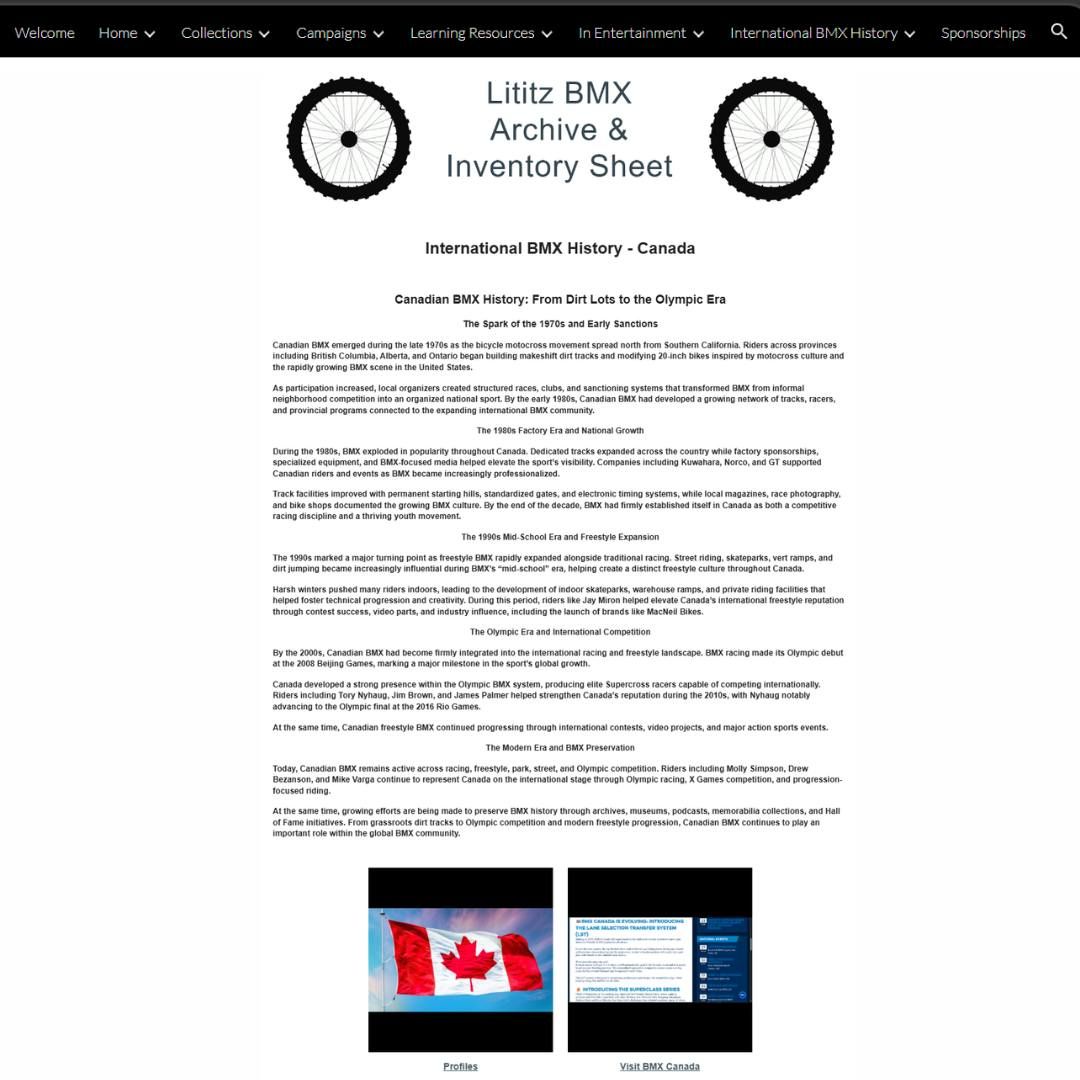
Canadian BMX History: From Dirt Lots to the Olympic Era

The Spark of the 1970s and Early Sanctions

Canadian BMX emerged during the late 1970s as the bicycle motocross movement spread north from Southern California. Riders across provinces including British Columbia, Alberta, and Ontario began building makeshift dirt tracks and modifying 20-inch bikes inspired by motocross culture and the rapidly growing BMX scene in the United States.

As participation increased, local organizers created structured races, clubs, and sanctioning systems that transformed BMX from informal neighborhood competition into an organized national sport. By the early 1980s, Canadian BMX had developed a growing network of tracks, racers, and provincial programs connected to the expanding international BMX community.

The 1980s Factory Era and National Growth

During the 1980s, BMX exploded in popularity throughout Canada. Dedicated tracks expanded across the country while factory sponsorships, specialized equipment, and BMX-focused media helped elevate the sport’s visibility. Companies including Kuwahara, Norco, and GT supported Canadian riders and events as BMX became increasingly professionalized.

Track facilities improved with permanent starting hills, standardized gates, and electronic timing systems, while local magazines, race photography, and bike shops documented the growing BMX culture. By the end of the decade, BMX had firmly established itself in Canada as both a competitive racing discipline and a thriving youth movement.

The 1990s Mid-School Era and Freestyle Expansion

The 1990s marked a major turning point as freestyle BMX rapidly expanded alongside traditional racing. Street riding, skateparks, vert ramps, and dirt jumping became increasingly influential during BMX’s “mid-school” era, helping create a distinct freestyle culture throughout Canada.

Harsh winters pushed many riders indoors, leading to the development of indoor skateparks, warehouse ramps, and private riding facilities that helped foster technical progression and creativity. During this period, riders like Jay Miron helped elevate Canada’s international freestyle reputation through contest success, video parts, and industry influence, including the launch of brands like MacNeil Bikes.

The Olympic Era and International Competition

By the 2000s, Canadian BMX had become firmly integrated into the international racing and freestyle landscape. BMX racing made its Olympic debut at the 2008 Beijing Games, marking a major milestone in the sport’s global growth.

Canada developed a strong presence within the Olympic BMX system, producing elite Supercross racers capable of competing internationally. Riders including Tory Nyhaug, Jim Brown, and James Palmer helped strengthen Canada’s reputation during the 2010s, with Nyhaug notably advancing to the Olympic final at the 2016 Rio Games.

At the same time, Canadian freestyle BMX continued progressing through international contests, video projects, and major action sports events.

The Modern Era and BMX Preservation

Today, Canadian BMX remains active across racing, freestyle, park, street, and Olympic competition. Riders including Molly Simpson, Drew Bezanson, and Mike Varga continue to represent Canada on the international stage through Olympic racing, X Games competition, and progression-focused riding.

At the same time, growing efforts are being made to preserve BMX history through archives, museums, podcasts, memorabilia collections, and Hall of Fame initiatives. From grassroots dirt tracks to Olympic competition and modern freestyle progression, Canadian BMX continues to play an important role within the global BMX community.

Site Link: https://sites.google.com/view/lititzbmxinventorylist/international-bmx-history/canada-international-bmx-history

www.LititzBMX.com #bmxracing #bmx #bmxlife #bikelife #bmxmuseum
Original exported text
Canadian BMX Friends - We Need Your Help: We are nearing 500 archived site pages and working towards that goal with building out our "International BMX" section.
We don't claim to know everything about everything - can you help us review for accuracy and site navigation?
There are currently 9 individual pages each, for: Rider Profiles, Track Profiles, and Event & Brand Profiles. A list of individual profile pages include:
Rider Profiles:
- Jay Miron
- Dave Osato
- Drew Bezanson
- Tory Nyhaug
- Molly Simpson
- James Palmer
- Mike Varga
- Jim Brown
- Amelia Walsh
Track Profiles:
- Whistler BMX - Whistler, British Columbia
- Calgary BMX Centre - Alberta
- Centennial Park BMX - Etobicoke, Ontario (Toronto)
- Kingston BMX - Ontario
- St. Albert BMX Association - Alberta
- Chilliwack BMX - British Columbia
- Falls BMX Park - Niagara Falls - Ontario
- Abbotsford BMX - British Columbia
- Joyride 150 - Markham - Ontario
Event & Brand Profiles:
- BMX Canada
- Canadian BMX & Hall of Fame
- Norco Bicycles
- MacNeil Bikes
- 10 Pack Distribution
- 1664 BMX
- Harvester Bikes
- 3Ride BMX Shop
- Metro Jam
Also, here a text version of the Canadian BMX write-up:
Canadian BMX History: From Dirt Lots to the Olympic Era
The Spark of the 1970s and Early Sanctions
Canadian BMX emerged during the late 1970s as the bicycle motocross movement spread north from Southern California. Riders across provinces including British Columbia, Alberta, and Ontario began building makeshift dirt tracks and modifying 20-inch bikes inspired by motocross culture and the rapidly growing BMX scene in the United States.
As participation increased, local organizers created structured races, clubs, and sanctioning systems that transformed BMX from informal neighborhood competition into an organized national sport. By the early 1980s, Canadian BMX had developed a growing network of tracks, racers, and provincial programs connected to the expanding international BMX community.
The 1980s Factory Era and National Growth
During the 1980s, BMX exploded in popularity throughout Canada. Dedicated tracks expanded across the country while factory sponsorships, specialized equipment, and BMX-focused media helped elevate the sportâs visibility. Companies including Kuwahara, Norco, and GT supported Canadian riders and events as BMX became increasingly professionalized.
Track facilities improved with permanent starting hills, standardized gates, and electronic timing systems, while local magazines, race photography, and bike shops documented the growing BMX culture. By the end of the decade, BMX had firmly established itself in Canada as both a competitive racing discipline and a thriving youth movement.
The 1990s Mid-School Era and Freestyle Expansion
The 1990s marked a major turning point as freestyle BMX rapidly expanded alongside traditional racing. Street riding, skateparks, vert ramps, and dirt jumping became increasingly influential during BMXâs âmid-schoolâ era, helping create a distinct freestyle culture throughout Canada.
Harsh winters pushed many riders indoors, leading to the development of indoor skateparks, warehouse ramps, and private riding facilities that helped foster technical progression and creativity. During this period, riders like Jay Miron helped elevate Canadaâs international freestyle reputation through contest success, video parts, and industry influence, including the launch of brands like MacNeil Bikes.
The Olympic Era and International Competition
By the 2000s, Canadian BMX had become firmly integrated into the international racing and freestyle landscape. BMX racing made its Olympic debut at the 2008 Beijing Games, marking a major milestone in the sportâs global growth.
Canada developed a strong presence within the Olympic BMX system, producing elite Supercross racers capable of competing internationally. Riders including Tory Nyhaug, Jim Brown, and James Palmer helped strengthen Canadaâs reputation during the 2010s, with Nyhaug notably advancing to the Olympic final at the 2016 Rio Games.
At the same time, Canadian freestyle BMX continued progressing through international contests, video projects, and major action sports events.
The Modern Era and BMX Preservation
Today, Canadian BMX remains active across racing, freestyle, park, street, and Olympic competition. Riders including Molly Simpson, Drew Bezanson, and Mike Varga continue to represent Canada on the international stage through Olympic racing, X Games competition, and progression-focused riding.
At the same time, growing efforts are being made to preserve BMX history through archives, museums, podcasts, memorabilia collections, and Hall of Fame initiatives. From grassroots dirt tracks to Olympic competition and modern freestyle progression, Canadian BMX continues to play an important role within the global BMX community.
Site Link: https://sites.google.com/view/lititzbmxinventorylist/international-bmx-history/canada-international-bmx-history
www.LititzBMX.com #bmxracing #bmx #bmxlife #bikelife #bmxmuseum
The original field is retained exactly as exported. The human-readable field repairs character-encoding damage only; it does not rewrite wording or correct claims.
Associated media
Media 1
- Media record:
FB-MEDIA-b25939734dd7fb209c - Asset:
FB-ASSET-506f1b105f13ad15 - Original export path:
this_profile's_activity_across_facebook/posts/media/Photos_122095015088769050/122203020392769050.jpg - Original SHA-256:
506f1b105f13ad15353285947198bc8a0abaf05c96b1fd9648afda2c9e8f6426 - Original dimensions: 1080 × 1080 px
- Public derivative:
assets/media/50/FB-ASSET-506f1b105f13ad15.jpg
External links preserved in the record
Hashtags
#bikelife · #bmx · #bmxlife · #bmxmuseum · #bmxracing
Controlled-topic occurrences
| Topic | Occurrences |
|---|---|
| Lititz BMX | 1 |
| RAD | 1 |
| museum | 2 |
Source reference
- Original JSON source:
posts/profile_posts_1.json - Source locator:
posts/profile_posts_1.json#[9616] - Source array index:
9616 - Record SHA-256:
ef48e3f4069248c139292062bb279de817028d1821c6be52d9d31ed072462c9d - Encoding repairs recorded: 2
| ← Previous post record | Facebook archive index | Search browser | Next post record → |